Surface irregularities on the planet that were identified as lava flows in 2024 are, according to the article, likely due to changes in the satellite’s viewing angle.

A team of researchers has published a scientific paper in Nature Astronomy questioning the evidence presented in a study that claimed recent volcanic eruptions on Venus, which was published two years ago and received widespread media attention (Sulanese et al., 2024).
The 2024 study identified a number of irregularities in radar data from the Magellan mission (1989–1994) and attributed them to possible lava flows that may have formed while the spacecraft was orbiting Venus. These flows were thought to be located in two regions of the planet: the volcano Sif Mons and the volcanic plain Niobe Planitia.
In response, a team of researchers with extensive expertise in the Magellan mission published a second study this April, arguing that while there is scientific evidence supporting present-day volcanic activity on Venus, the specific claims made in the 2024 study are not supported by sufficiently robust evidence.
“The anomalies between the radar images presented in the study by Sulanese et al. could be attributed to changes in the radar’s orientation across different passes,” explains Gerard Gallardo i Peres, a planetary scientist at Imperial College London and at isardSAT. “Contrasts like those identified in the study can occur when the same terrain is observed twice from substantially different radar angles. Moreover, the geological context of these areas makes the existence of the proposed new lava flows highly questionable,” Gallardo i Peres adds.
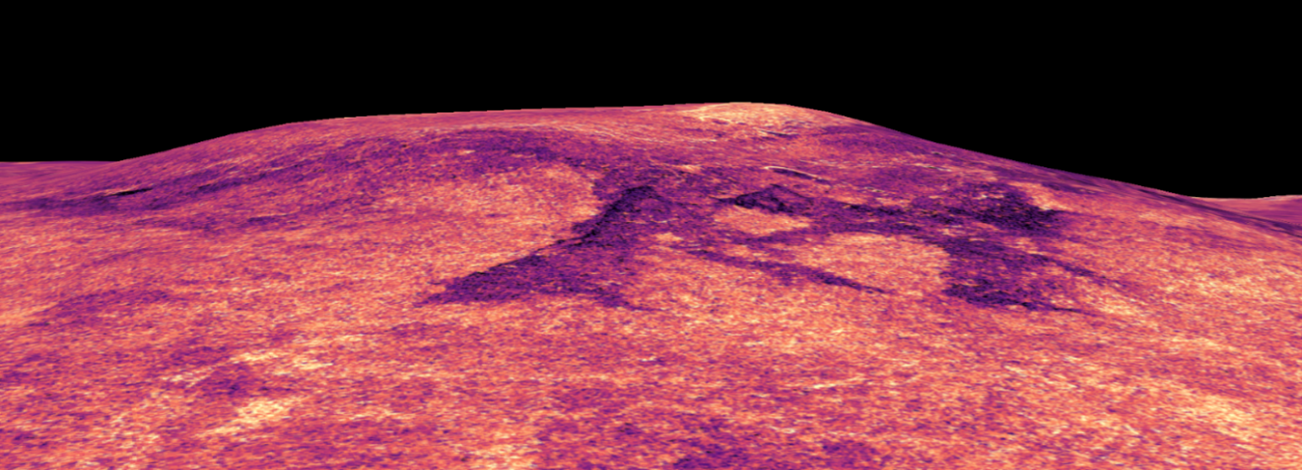 Reconstruction of the western flank of Sif Mons on Venus, with a vertical exaggeration of ×10, showing younger lava flows in magenta spreading westward from the summit. Image created using altimetric data from the Magellan Global Topographic Data Record (GTDR).
Understanding Venus to comprehend Earth’s evolution
The recent study highlights the importance of such nuances when it comes to reliably demonstrating any geological change on Venus. “In the context of radar-based change detection, it is essential to distinguish between possible geological activity and distortions arising from changes in the sensor or data processing,” the researcher explains. “On Earth, comparing radar images with different characteristics is still a developing field. On Venus, with the data currently available, it is very difficult to draw conclusions with the necessary scientific rigor. This is why new missions are so important.”
Upcoming missions to Venus carrying orbital radar instruments—EnVision, led by the European Space Agency, and VERITAS, led by NASA—will acquire topographic measurements at a resolution comparable to the imagery from Magellan. This will make it possible to rigorously quantify volcanic eruptions across the planet.

Venus is the planet in the Solar System most similar to Earth, yet its atmosphere exhibits vastly different conditions—partly due to its volcanic activity. “Understanding the timeline of this activity will provide insight into the origin of the planet’s extreme climate conditions. In turn, this will help us anticipate the future behaviour of Earth’s climate and improve our understanding of the evolution of terrestrial planets beyond our Solar System,” the researcher adds.